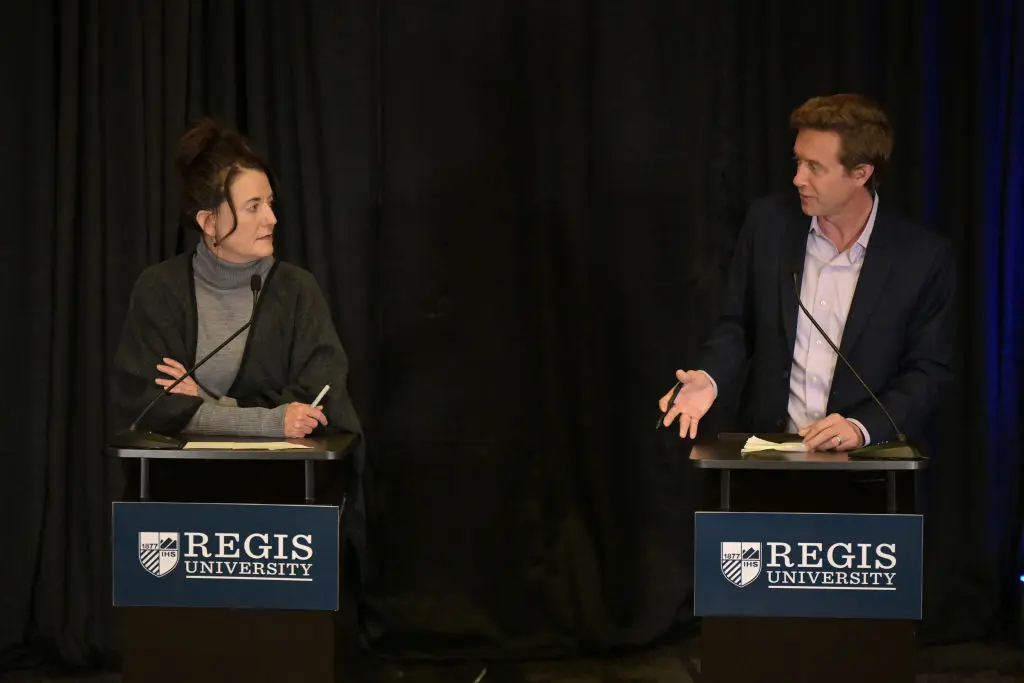
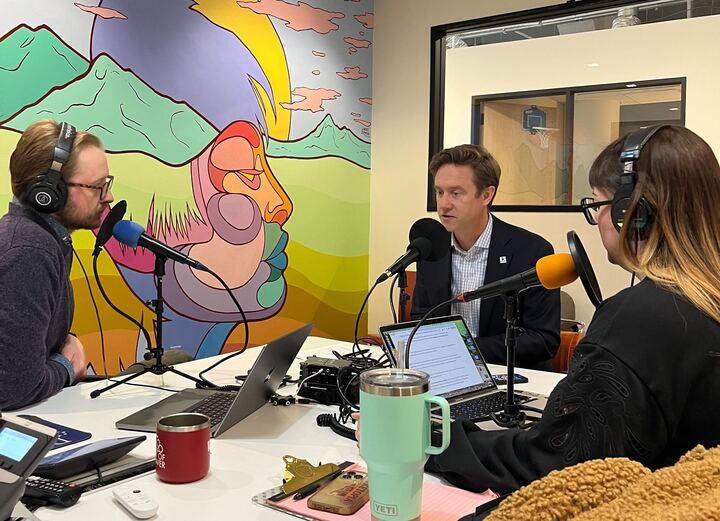
With busloads of migrants still arriving in Denver nearly every day, Mayor Mike Johnston just returned from a second trip to Washington, DC, lobbying the federal government for emergency action. So in our semi-regular sit-down with the mayor, host Bree Davies and producer Paul Karolyi ask the mayor why this situation is so dire right now, what happens if Congress can’t agree on a new immigration bill, and whether or not he’d be willing to risk prison time testing out the innovative new legal theory we discussed on Monday’s episode. Plus, we get the deets on his increasingly iconic corduroy jacket, question his commitment to multi-modal transportation post-¡Viva! Streets’ cancellation, and give him a listener question on the snowplowing problems we all know are coming soon.
This is an unedited transcript of an interview. Please forgive any formatting, grammar, and punctuation errors.
Bree: Mayor Mike Johnston, welcome back to City Cast Denver
Mayor Johnston: Thank you so much. Delighted to be back. Thanks for having me.
Bree: So, I've been talking to some political insiders, and I have this burning question that they've been asking me to ask you, and it's about your fur lined khaki corduroy jacket. You wore it to meet the president, it's like kind of your signature look. I need to know, who is it by? Is it Wrangler? I, I have two guesses here I've been sent by my political insiders. Wrangler? Ralph Lauren?
Mayor Johnston: It is, it is Wrangler. It is, yes.
Bree: Okay, you heard it here first. It's a Wrangler jacket.
Paul: We have no joke been debating this for weeks.I think since you had that post about with you and then Taylor Swift in a very similar looking jacket,
Bree: Oh yeah
Mayor Johnston: That was the first time my daughter thought I might be cool. I was like, at least also Taylor Swift wears a similarly themed jacket.Then she stopped being embarrassed .
Bree: Enjoy that singular moment where she thinks you're cool.
Mayor Johnston: It will not last for long.
Paul: There is one note on this, this, while we're talking about the jacket, we were talking to our friend, Patty Calhoun from Westwood about this. She's just as keen on this as us. She wanted to know if it's, if it's fur lined.
Mayor Johnston: No, it's not. It's just wool.
Paul: Okay, well, animal product. Cause her thing was like, there's this ballot measure coming that's gonna ban slaughterhouses and fur. Do you have thoughts on that? I know this is months out, but she was like, you gotta ask about the slaughterhouses. I'm not sure
Mayor Johnston: I have not seen this. I don't…
Bree: It was kind of a surprise to us, too. There's not been a lot of coverage of this slaughterhouse bill
Mayor Johnston: I do not own any fur products that I'm aware of. I think I might have, when I was like 15 and I went to Russia, they gave me a, some sort of hat in exchange that I still have in the basement of my closet, but I do not otherwise have any products. So I, I, would have to read the measure. I've learned enough to know I should probably read these ballot measures before I jump in and opine on them. So that's a new one for me. It was not on my, not on my list.
Paul: Maybe, maybe we'll talk about it later in the year. Anyway, so we talked about your, you, you met the president recently.
Mayor Johnston: Yes.
Paul: You were in DC to talk about this wave of migrants we've had here in Denver, almost, nearly 40,000 have arrived since 2022.
Mayor Johnston: Yes
Paul: We know you've been pushing for more money, for fast tracking work authorizations. Is there a chance we're gonna see those things?
Mayor Johnston: You know, I think there is a chance. I was in D. C. last week, and so, the only challenge is it quite literally requires an act of Congress, so you have to get bipartisan agreement on a measure to solve this. I met with a lot of folks last week, including the Secretary of Homeland Security and the Senators who are drafting this measure, and they seem quite confident that they will have a bipartisan bill in the Senate that would include, both Resources for cities, and also would include some expedited plan for work authorization. So, the good news is we think there will be some version of what we've been asking for in a Senate bill. The question whether those things will pass a House is a totally different question. I think the, you know, when even you have like John Cornyn, who's quite Republican, coming out and saying the question is just whether our colleagues actually want to solve this problem or want to just keep this problem going for political gain.I think that is the dilemma. I think Trump will certainly weigh in and say, Whatever you do, don't, don't pass anything. 'cause I wanna be able to beat the country up over why this is a problem. I think there are well intended people on both sides who actually want to at least make a positive step in the right direction.And I'm hopeful those angels of our better nature will prevail.
Paul: I mean, I mean, but you mentioned Trump. This is an election year. I mean, we all know Congress. What happens if we don't get this support?
Mayor Johnston: , it is, the scenarios are quite dire for us, which is why we are pushing so hard on this. I joke it's the other Mike Johnson, you know, it's like the Speaker of the House is sort of our challenge.. We have no special connection, given that we have almost the same name. That's not helped me at all yet. , but I think this is why we are pushing is because there are, you know, the federal government has done things that have been helpful for us through executive order. So, for instance For people that have followed this, and I think you had an immigration expert on that earlier, and so, when we, I met with Mayorkas in July with Polis, and we really pushed him on this work authorization thing, and then he came out a week or two after and, and created this, the temporary protective status for Venezuelans, which allowed them to work. And so that meant anyone that arrived before August 1st could get work authorization in Denver. That kept us alive through the summer and the fall. That was why almost all the folks that arrived could work almost immediately. We got them into housing. You may remember we had next to no migrants who were unhoused probably until November.And that was because that was by November was when all that work authorization started to run out. So there are things you can do with executive order or with , parole power of the secretary. You also may be seeing this week The Secretary of Homeland Security is now facing impeachment in the House for that exact tool that we asked him to utilize, so there's obviously resistance, but there's a lot that can be done through executive order, but the resources for cities requires congressional action, and so for us, if the no bill passes, we're left with a bunch of sub optimal choices, but the biggest problem is we wouldn't have any financial support, and that means the 150 or 180 million hole in the budget still stays there, and that's what we are trying hardest to avoid.
Paul: Yeah, I mean, that's, I think what people are concerned about is that's a lot of money.
Mayor Johnston: It is, it makes it, would make it one of the largest departments in the city. I mean, at that stage, it's 10 or 15 percent of the budget.
Paul: And You've already called for various city agencies to look for cuts to help fill that gap. but that means like a reduction in services, right? What do you say to Denverites who are concerned about this, spending all this money helping migrants when we all need help?
Mayor Johnston: Yeah. , when I talked to my team, I said, you know, this is what, we call a dilemma, not a problem, which is a problem is there's a solution, you find the solution, you fix it.A dilemma is you have competing values on both sides and one of them is not right or wrong. You share both of them and you have to balance them. Our values in the city are we do not want women and their two year old children sleeping in tents outside in the street in 10 degree weather. We don't want that., and our value is we also want to provide high quality services to everyone else in the city that needs those services. And the challenge is those two are at odds right now, you know. And so what we're trying to do is figure out what we can do to avoid that. So we're doing three things at the same time.One is we're pushing very hard for federal support that would help reduce those cuts or impact. , the second is we are having departments look at proposals for how they could make cuts without impacting services to every extent possible. And the third is we're looking at how we could change the level of services we provide to migrants to reduce the cost of those services.But those would be hard choices. Those would be things like dramatically reducing the number of days someone had in shelter, maybe limiting the total number of units we could have for shelter, which would mean there'd have to be a cap on how many folks we could serve, and we wouldn't be able to serve people above that cap.And so, it's going to force hard choices in all directions, but we're trying to look at all three options and then see what comes out as the best combination of those to not cut services.
Bree: And you just kind of touched on this, which is last week you announced that migrant families will not be able to stay in shelters indefinitely. And as you just said, this means kids might be on the street. You're a parent. I'm a parent. This is something I think about when I think about seeing these folks. I can't imagine raising a toddler in a, in a tent. I mean, how do you feel about having to make that decision?
Mayor Johnston: Yeah, this was an incredibly hard decision to make. For those that are following along at home, we have always had a length of stay commitment.It used to be that it was 14, days for an individual, and it used to be, about 35 days for families. We moved up to almost 42 days, so it's about six weeks for families. , but then what happened is when we came through November and December, we had a number of those stretches of really, really cold patches, and we did not want to exit people onto the streets in 10 degree weather. So we paused on releasing any , any families. That was great. , that was also one of the reasons why our numbers have gone up so dramatically as we have not required anyone to leave since almost Thanksgiving. , and so , that means that's why we're at 5, 000 right now and the challenging part is 4, 200 of those 5, 000 are families. , so they are parents and kids. There's only about 600 single adults right now because we have been still continuing to release , single adults. The challenge, Bree, is it's actually not between do you want to serve a family or not. It's do you want to serve a family that's been here six weeks or the one that arrives tomorrow? Because at this point, we have now filled every single unit we have in Denver. And as you know, some of our surrounding counties have not been jumping at the opportunity to help us access housing in their sites.So what we are doing is we're dramatically ramping up our housing navigation support. There's heroic teams at the city led by, Donya and Riley and Lana Dalton and some other people who've been developing really tremendous success getting our migrants housed. It's interesting to our previous conversations about homelessness. A lot of our migrant newcomers are actually much easier to get into housing because they don't have any negative rental history. They don't have bad credit. They don't have an eviction on their record. They don't have maybe any significant histories of abuse or mental health needs. And so that means on a rental application, they show up as actually lower risk than someone that might have been chronically homeless in Denver. And so, we've had a lot of success with that. We'll keep doing that. We've brought on some additional family sites. So to your concern about what will happen to families, we brought, we opened a site up in northwest Denver that's a family shelter for migrant families.We're working on one on the east side. So we are doing, we opened the two congregate sites for folks that were unhoused, that were former migrants. And the reason why we've done that separately is because they really are very different populations with very different needs. , in some ways, the challenges that someone who's been chronically unhoused for two years can face might seem more daunting if you have real histories of trauma and mental health or addiction needs, but if you're also facing a six year wait for an asylum application with no plan for work authorization, I mean that can feel very daunting as well. So they just have different needs and different paths, we’ve tried to provide the right sets of services to both, and I'd say what's most frustrating about the lack of federal action is we actually know what it takes to make this work. Like, we've successfully welcomed 36,000 people to this city, and they've almost all integrated very effectively. , it's just at this stage where now work authorization has run out, the vole's gone up dramatically, and the dollars have disappeared. We can't do without all three of those at the same time. That's the challenge.
Bree: How do you think that, the, the costs and the work you're doing to support the migrants, how is that, is that going to get in the way of your House 1000 plan or that, the plan that you already kind of already had rolling?
Mayor Johnston: So this is the, I think this is the why it's a big concern for us is it's not just house a thousand. It's if you care about bike lanes or if you care about recycling and trash pickup or if you care about presence of, you know. Response time for 3 1 1, concerns or 9 1 1 calls. So we want to not impact any of those core public services, and we also know 180 million dollars is not something you can just find in the couch cushions without making an impact. That is very, very hard for us to do without having to make some modification. We're not going to back off on our commitments on either , getting folks off the streets and into housing, on really expanding affordable housing for all income levels across the city this year, on increasing public safety both through activation of streets as well as through more officers. And so, we're trying. As I talk to departments, we're not backing off of those goals, but we know it's very hard to ask departments to do more. And also spend less, and so that's why we're trying to be as creative as possible about where the places are that we can make adjustments.And I've lived through budget cuts before myself, you know, personally, as an organization head, as a legislator. And what you have to do is look at what are the things we're doing that are really working and working really well? What are the things that if we had to take an honest look we'd say aren't working as well and probably aren't the best investments for the city and can we do less of those or fewer of those? And so they are right now in the next two weeks doing that investigation themselves, the deep look on where do we think if we had to cut 10 percent from my budget, what are the things that would make the least impact on services? They'll come back to me with a whole series of proposals in the next few weeks. Then we'll look at that and say what are the things we really couldn't see ourselves doing, what are the things that we think could be possible, and then what is the balance between where we have to make cuts to the city, where we have to make cuts to potentially some of the services we have available for migrants currently, and where we can look for other ways to fill that in with federal help, like more work authorization or more federal dollars.So it's a three part kind of puzzle to put together as we get all that information, but , I don't have it back from the department, so that will come in the next few weeks.
Paul: So here's something we want to talk about. This is, you mentioned earlier that we talked to an immigration lawyer, on the show, a few days ago. This is our episode that ran on Monday. Cesar Cuatemoc Garcia Hernandez. He had a really exciting idea inspired by some, some legal thinkers at the University of California system.
Mayor Johnston: Ahilan. I talked to him last week. The UCLA law professor? Yeah, yeah.
Paul: Oh, interesting.
Mayor Johnston: I’ve been calling every law professor in the country to ask the same question. So, yeah.
Paul: Let me give for the listener who maybe missed that episode. Basically, the idea is, if the problem is work authorizations for migrants, why doesn't the city just hire them? Because that would trigger this challenge of the interpretation of a federal law that's been on the books since 1986 that many people have said would ban this, but this guy we talked to said, let's try it. You know, maybe there's time for a new interpretation. You talked to one of the originators of this idea. What do you think?
Mayor Johnston: , yeah. So for those lawyers listening from home, the idea is IRCA, which is the Original Immigration Rights Act. , there is a theory by some law professors that that does not apply to cities or states.That as other public actors, we are immune from application of this federal law. And so what UCLA is trying to do is use it to hire, undocented students who want to do work study. And so for, you all know this, but I originally got into politics in the first place because I had a lot of students who were undocented who we couldn't get into college because they had to pay out of state tuition, which was the same challenge, and so we've been working on this for a long time., it is one legal theory. They have about 20 or so law professors who have signed on to the belief that the, that the law is unclear on this issue, and so we think there is the ability for cities or states to, to try this. It's a potential test case. .
Paul: I thought this was super exciting.
Mayor Johnston: I mean, so there are six or seven different ideas we've all been looking at that are in this, area that we think are all legal, they're not currently being practiced, and, we're trying to look at what the best ones are to try.Here is the risk for us, is that right now, we could test case these, we could try them because we think they're legal, if they were later found to not be legal, the statute of limitations on many of these is three years. Which means if, hypothetically, 11 months from now you were to have a presidential election and someone like a Donald Trp were to win and make it his signature accomplishment to try to prosecute any city, state, individual, non profit that did this, you could sell people that would face criminal charges that were people that were trying to do what they thought was right.
The other risk for us that we're very mindful of is an individual migrant who participates in this program. If they were to do one of these programs that we think is legal and is later found to be not lawful, they would be penalized by being barred from future admission and they could be barred from their asylum claims.So, there's one thing of, would we be willing to take a risk on something we think is legal? I'm very willing to take risks on things we believe are legal. What I don't want to do is adversely impact, a new arrival who's an asylum seeker and doesn't understand the nuances of federal law and says, sure, a job, I can take it.
, they can face consequences for working without documentation. And so we're trying to look at the best possible solution that we think Supports the city's success and supports a newcomer's success. , that is one of the theories we're looking at, along with three or four others, and if no federal resources at all come, I think we would have to be much more creative and aggressive about how to find legal solutions that we think we could push.
Paul: Well, that's very sympathetic. , have you asked anyone if they would want a job and to be the face of this challenge? Because I can imagine someone wanting to be very bold.
Mayor Johnston: Yeah, I mean, one of the things that gives me humility is I've spent, you know, I actually went to law school that my wife would say I'm not really a real lawyer, but, and I've spent the last six months just trying to understand the legal parameters of immigration law and it is incredibly complicated.And you think about you're someone who, you know, there's a woman in Denver who I , who was a police officer in Venezuela. She was asked to tear gas a room full of children and elderly people. She refused to do it. They came to her house in the middle of the night to try to kill her with the state police. So she takes her two kids, puts them on her back, and walks 3, 000 miles to the United States just thinking, you get here and it will be okay. Like, she wasn't researching IRCA 1986 federal legislation or what the work authorization prescriptions are. So they get to Denver and just say, Hey, Mr. Mayor, I'm here, ready to work, can you give me a job?
Or like, give me the paper thing, like, who does that? And with no knowledge that it's a federal law that requires federal change in the city. The hardest conversation I have every time I talk to migrants is them saying, but why, I don't get it. Why can't I just work? Like, just let me have a job. , and so, I, I think there are people that are willing to take those risks, we just want to not, adversely affect their long term chances of, of getting, green card or work authorization. , and so we're trying to balance the two. Right now, we have an amazing group of, legal experts who are helping us. , Kristen Bronson at the Colorado Lawyers Committee and other people on our team, including our city attorney, have been working on We have about 300 volunteer attorneys they've pulled together who will help people start doing Asylum applications, and , it's called Temporary Protective Status is what you can apply for.It's, or there's a Customs and Border Protection app called CBP 1. So if people have come through either of those avenues, they're ready, eligible for work authorization immediately. And what Homeland Security has told us is up to about 75 percent of people who are in the country and could apply for that have still not applied because they also don't know how the paperwork works.So we're trying to very aggressively put people through the legal clinics first. The other thing we can do is have everyone apply for asylum, and once you've applied for asylum, you're eligible for work after 150 days, still 5 months, longer than we want. But so our first effort is to put everyone through these applications that we can, so they're in line, at least for the, for legal work applications, and then we'll start to see what our other options are if these are not successful.
Paul: I have to go back to this. I'm just not sure I heard a yes or a no there. Have you talked to somebody about whether or not they'd be willing to take this risk?
Mayor Johnston: To a, to a newcomer, to a migrant?
Paul: I’ve heard your Spanish. It sounds good to me. I believe you could explain it.
Mayor Johnston: , we have, we have talked, yes, we have talked to them about that there are multiple creative options, all of which are legal, in our mind., and they have been very willing to try that. , and so, we, we have not yet tried this UCLA strategy, but we're very aware of it. We've talked to the experts. We think we understand what the path would look like, and we're just trying to balance what we think the best versions are with the least legal risk. But yes, we have talked to them, and they are very willing to take risks. You're correct
Paul: Im curious, the other side is you, is whether or not you’re willing to do it, right? ‘Cause that’s what you said, if Trump comes into office, which i understand is a big risk, criminal penalties, that sounded like you going to jail.
Mayor Johnston: It could, I think that's the worst case scenario. I'm willing to take that risk, I don't want to put city employees at that risk, and so I think what we're trying to look at is what, what is the protections we make sure we have, if we're doing something that we believe, again, we believe clearly is legal, we wouldn't do something we don't think is legal because we think the law is on our side, but we know it'll be litigated and we just want to be ready for that.
Paul: Okay. Okay.
Bree: We're going to switch gears, we're going to talk transit. The Downtown Denver Partnership canceled the Downtown car-free streets days, Viva Streets, this year. Transit advocates are upset because they think that it would contribute to our transit and climate goals to have this event, and it would bring some life back downtown. , they're currently circulating a petition to try to save Viva Streets. Mayor, what do you think about it?
Mayor Johnston: I thought Viva Streets was a fantastic initiative. I was delighted to join it as just a civilian out riding bike or walking, with my kids. And so I do think it did a great job of activating the city and neighborhoods across the city, connecting people to different neighborhoods. So, I'm a big fan. , and so, I was disappointed that there was a pause this year and I understand the reason why Downtown Denver Partnership did it. , I think linked to our other conversations, it is, I think, roughly a two to three million dollar cost for Downtown Denver Partnership to, to make it happen.
Paul: Oh really, that’s quite a bit higher than I even heard.
Mayor Johnston: I think that's the last number I've seen. If I'm wrong, I'll let you know and apologize, retroactively. But that's, I think, the last number I saw. And, and they paid for this out of their own, you know, that was not a There was some city funding, but it was a small percentage. , we do have things that we do, like off duty officers and the rest, but they, they made a big investment to do this, and I think they wanted to test the case, and I think the test worked.I mean, people really liked it. , to me, this is, it looks like more of a reorganization of, OK, this worked well. If we want to do this as an ongoing effort, what's it going to take to really get a broad, permanent base of supporters, of funding, and long term rollout? , so I would view this as a pause, not a stop., but I think that they, they, Courageously move fast to stand this up in year one and then found it was a little more complicated than they thought and so Everyone I've talked to likes it wants to make it happen again. We'd be supportive of doing that too So I'm very optimistic it will come back in some form and I will be delighted to be out there riding with folks when it does.
Bree: When you say it's not, it's not canceled, it's a pause, I'm still thinking about something that I hear transit advocates say is getting people into new habits means you have to be able to have those opportunities to create those habits over and over again. And, you know, making this sort of not a permanent thing that we do every year. I could see where some folks would think that this sort of indicates maybe a lack of dedication to getting Denverites out of their cars, needing to hit our climate goals? Do you think that this says something about your approach to, to transit?
Mayor Johnston: Well, to be clear, this was a decision made by the Downtown Neighborhood Partnership. It was not by our administration. I actually found out about it in the paper the same way that everyone else did. , and I, and I understand why they made the decision, but it was not something that we led or pushed for. ,we were excited to support it or are willing to support it going forward. And so I don't think it represents at all a Move from our administration away from the idea of new habits of being. And I don't think it stops our ability to push for lots of opportunities to find those new habits in addition to Viva Streets.I mean, Viva Streets was, I think, four fantastic Sundays. , I think part of what we're after is how do we make this a regular habit for someone on a Monday and a Thursday and a Friday on the way to and from work or to and from errands. And so, it won't at all slow down our efforts to really push people's behavior changes around, more use of walking and biking and, Public transit as a strategy that will continue to be clear for us and we'll be excited to work with With ddp on the next iteration of it, too.
Paul: Well, I want to get excited about something. What's the next thing you're working on? What are these new efforts and when it comes to transit?
Mayor Johnston: Oh well, great question. We just brought on a new head of DOTI, which is our Department of Transportation infrastructure. Wonderful. A woman named Amy Ford who just began and she is a real expert in mobility. I think she's had a lot of experience in this, and so I think she is leading right now, an, a look across all of the city on what the things are that we're doing that are working really well. One of the things we wanna do more of, what are the things maybe that aren't working as well that we want to cut back on?, I, we did wanna let her. Get her feet wet, get in place, meet the team, and do a survey of all of these opportunities. I know we want to come back to talk again about Vision Zero and talk about how we're going to reduce pedestrian deaths around the city. That continues to be a top priority. How we look at, high traffic hotspots in places that we know are the most dangerous and what we can do to try to slow traffic and, protect pedestrians in those places., and then we're going to keep looking at what we can do to expand, our walking and biking routes and arteries around the city that make it easier for you to get Neighborhood to neighborhood, work to play, work to home, and so I think those will all still be coming. I don't want to jump over Amy's leadership there to release anything before she's ready to go, but we are really excited to have her on board and taking a deep dive on these issues right now.She's only about three weeks in, so just got started.
Paul: Well, we'll have to talk to her
Mayor Johnston: Yes, you should bring her on. She's fantastic.
Paul: I look forward to meeting her. Well, I think we should wrap up with a question we got from a listener.
Mayor Johnston: Great.
Voicemail: Hi there. My name is Tila and I actually live in Lakewood, but I work in Denver and for my job I have to drive all over and I'm calling on the 26th and we just got a couple inches of snow, nothing crazy, and I wanted to talk about snow plowing again. I know it was a huge thing around the Mayoral race back when we had 18 candidates or whatever. And I don't know I just drove in on 6th and like the highway portion was fine. But as soon as I crossed into sort of Denver proper like around Santa Fe, it didn't look like it had been plowed at all and it was a mess, and I mean Colfax is fine, but you hit any side street and they haven't been touched even like 14th was a mess. So I just thought of an update on what our new mayor is doing about this. Thanks so much.
Mayor Johnston: Great question.
Paul: Thanks, Tila.
Mayor Johnston: It's fun to go back to the moment when snow plowing was one of our bigger crises. I wish that were… That does not require an act of Congress to fix, it turns out. So thank you for the question. We are doing a couple things. One is, obviously, yes, we're, of course, still plowing arteries. But we have now started deploying more snow plowing efforts to side streets. And as you know, this is one of those dilemma questions where some folks in the environmental community were concerned that more plowing on side streets can bring up more particulates and dust that potentially have environmental impacts. And so, we think that is true. And also, we think having your 87 year old grandmother need to walk down a street that's an icing rink is also not safe for residents.And we think we need to solve that. And so, we are, this year, have been doing more side street plowing, to both test impact and response. This is a good data point. I wrote down those streets. So we'll go double check this may have been at the last storm that you called. But we are we are tending more towards more coverage of more streets including more of the side streets as the strategy and I think we've if anything Over indexed on that this year and then we'll take a look at the end of the winter and see what people's feedback is , I still have a north facing house.So we still have a ice rink in front of my sidewalk no matter what I do.
Paul: Same. My God.
Bree: I grew up on what we called Ice Mountain
Mayor Johnston: I feel like I was the worst home buyer because I did not ask that question.
Bree: It is literally something my mother made me.
Mayor Johnston: Yeah.
Bree: Like when we were looking at houses, she's like, no, no north facing. Remember what you grew up on.
Mayor Johnston: Yeah, no, I missed that totally. So…but yeah, so we are hoping to make much better roads on those side roads. And so hopefully, you'll see that outcome if there's still streets that you think are not clear and should be, send them to us on 311 and we will, we will circle back on those.
Paul: Alright.
Bree: An answer for something we're not dealing with right now. It's hard to think about it when we're not on the road raging about it, but it will come up probably in three days.
Mayor Johnston: It will come back. It’s for sure coming back.
Bree: Well, Mayor Johnson, thank you so much for joining me.
Mayor Johnston: It’s good to see you. I always love coming back. Thanks for having me.